For companies with a stack they inheritedNo coding required

Your company’s apps,
built by your company.

No coding required. The tools your operations, field and finance teams keep asking for — specified from what they already have, signed off by the people you choose, and shipped to web, desktop and phone on one OS.

Arden Freight · Work Orders
1 · What you bring

Calls, emails, notes

Screenshots, links, a photo of the paper form. Drop in whatever you already have.

2 · The spec

One blueprint, signed off

Spec Studio reads all of it and draws one spec, every decision cited to where it came from. Nothing is built until it’s approved.

3 · Your app

Work Orders

App Factory builds it from the spec in Arden Freight’s own brand — for web, desktop and phone.

Arden Freight, Northwind Utilities and Harbor & Pine are example companies.
Your stack today

Your current stack is a spreadsheet.
None of it is yours.

Stale renewal dates. Owners who left in 2023. Feature requests nobody remembers submitting. It isn’t a vendor list — it’s a map of the decisions you’ve already lost leverage on.

  1. Renewals are trapsWhen a vendor raises rates or sunsets a feature, your data is their leverage.
  2. Feature requests stall in queuesVendors build for their biggest customers. Your workarounds become permanent.
  3. Compliance is a screenshot jobThe auditor asks “how do you know?” and you screenshot twelve dashboards.

The renewal wall

Four hundred contracts renewed themselves
and nobody decided anything.

Every one of them has a notice window — thirty days, sixty, ninety — and the window is the only moment you have a choice. Miss it and the contract renews itself, silently, for another year. Your stack is not a set of decisions. It is a set of deadlines you missed.

MonthJAN
Auto-renewed0
Actually decided0
An illustration of one year and 400 contracts, of which 36 were watched. The numbers are drawn, not measured.
EVERY CONTRACT YOU HOLD, BY RENEWAL DATEJFMAMJJASONDOne contract · one notice datea decision, taken on purpose
Migrate · early access

It’s finally time to migrate
those 20-year-old Access databases.

The asset register, the maintenance log, the supplier price book — built in 2003 by a plant engineer who has since retired, running on a PC in the plant office, and load-bearing for a line that cannot stop. Its tables become a real app’s database, its rows load after a dry-run preview — and not one row is ever sent to an AI model.

The company of the future

It runs on one OS.
It gets there one renewal at a time.

Four hundred vendor systems today, inherited from six acquisitions and a decade of departments buying their own way out of a problem. Each one leaves on its own renewal date — no program, no big bang — and what it did becomes an app you own. The systems of record stay, connected.

Year2026
Vendor systems400
Apps you own0
An illustration of one company over five years.
ERPCRMHRISWMSMESPAYROLLDATA WAREHOUSEIDENTITYYOUR OS202620272028202920302031today: 400 vendor systemsone team, one appthe first renewal waveops leads are building nowthe ERP stays, connectedone OS
The integration tax

Eighteen tools.
A hundred and fifty-three ways to disagree.

Nobody buys an integration. You buy eighteen products, and then you pay, forever, for every pair of them that has to agree about a customer, an employee or a price. Point-to-point grows by n(n−1)/2; one substrate grows by n. That is not a claim about our software — it is the shape of the problem, and it is why the bill never goes down.

Point-to-point wires0
On one substrate0
Drawn as though every pair must agree — the worst case, and the one every integration roadmap eventually meets.
TODAY · POINT TO POINTCRMERPHRISPayrollTicketingWarehouseField serviceBillingQuotingE-commerceAnalyticsData warehouseMarketingSupportContractsProcurementExpensesSchedulingON ONE SUBSTRATECRMERPHRISPayrollTicketingWarehouseField serviceBillingQuotingE-commerceAnalyticsData warehouseMarketingSupportContractsProcurementExpensesSchedulingONERECORD153 wires. every one is somebody’s Tuesday.18 wires. the customer is one row.
Everyone on the payroll

One company, five people.
Each one sees only their apps.

The operations lead on the floor, the technician at the van, the analyst at a desk, the HR partner by the break-room counter, the service lead with a headset round his neck. One app, one sign-in — and each person opens it to the apps that are theirs. Your customers sign into the same app and see their own orders, nothing else.

same company, five people
  1. A field technician at the open door of a service van, phone in hand, looking off down the street
    Field
    8 apps
    Marcus, field technician
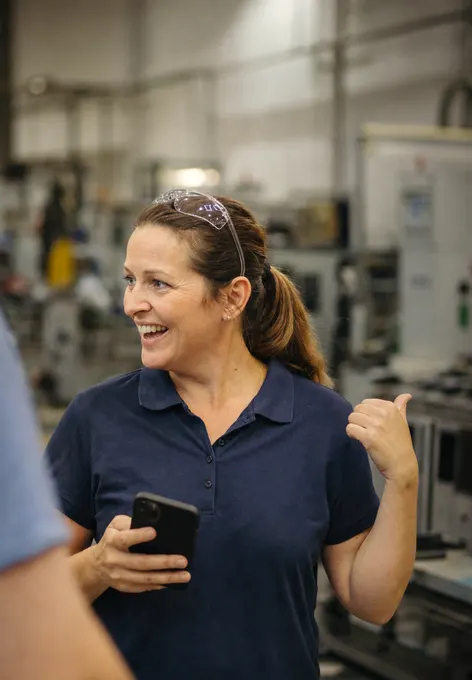
  2. An operations lead on a manufacturing floor mid-conversation, grinning and pointing back over her shoulder
    Operations
    11 apps
    Kerry, operations lead
  3. A finance analyst turning from two monitors to laugh with a colleague, phone in hand
    Finance
    10 apps
    Ren, finance analyst
  4. An HR partner listening attentively beside a break-room counter, phone resting in one hand
    People
    9 apps
    Alma, HR partner
  5. A customer-service lead at a stand-up desk turning to answer someone, headset round his neck, phone raised
    Customer service
    7 apps
    Nate, service lead
Arden Freight, its people and its apps are examples.
Governance

Gates at every step in the development lifecycle.
Maximum control for highly regulated industries.

Choose the gates you want — the request, the spec, the build, security, production. Each one is enforced in the code, not in a change-management deck, and every decision lands in one trail you can hand an auditor, a customer’s security review or your own board.

turn a gate on in watch mode first —
see what it would have blocked
  1. S. DelacroixCOO · sponsor
    APPROVEDrequest · 08:12
    New app
  2. K. AmherstPlant operations
    APPROVEDspec rev A · 09:41
    Spec sign-off
    A supervisor asked for it.
    A supervisor can’t approve it.
  3. V. RaoEnterprise applications · any 1 of 3
    APPROVEDhand-off to build · 10:05
    Build
  4. Latest scan 11:240 critical · 0 high
    CLEAREDsecurity posture · 11:30
    Security
    no scan yet? blocked.
    no scan is not a clean scan.
  5. D. Feld · N. BarrowCISO · VP Operations
    APPROVED · 2 OF 2commit 9f42ab1 · 14:06
    Production
    9f42ab1 is approved.
    5ce8072 has to ask again.
Governance auditEvery governance decision in your org, in one trail you can hand an auditor.
TimeGateResultWhoWhat
08:12New appClearedS. DelacroixWork Orders request, sponsor approved
09:41Spec sign-offClearedK. Amherstspec rev A
10:52SecurityBlocked—release held: no completed scan
11:30SecurityClearedscan 11:240 critical, 0 high
14:06ProductionClearedD. Feld, N. Barrowcommit 9f42ab1, 2 of 2
14:31ProductionBlockedJ. Okaforcommit 5ce8072 has no approval
People and apps are examples. Gates are off until your company turns them on.
Born compliant

Customer data never leaves quietly.
Every crossing gets a receipt.

Your customers’ security reviews ask one question you cannot currently answer in writing: which of your vendors saw their data, and what exactly did you send? Declare your regime and the platform fails closed — approved destinations only, redaction before the call, and a receipt for every crossing, in a chain that shows if anyone edits the past.

Governance, in the product

Your approval committee,
built into the software.

Org HQ ▸ Governance. Four screens your compliance officer will actually open.

Org HQ ▸ Governance ▸ Gates
Every lifecycle gate — its governor, approvers, and enforcement — in one registry.
New app
Spec sign-off
The rule: Before anything is built, at least 2 of these people must approve the spec.
Who can approve: Dr. A. Rahman · K. Osei · J. Tran
Kept in the loop — Notified of every request and decision — they don’t approve.
Changes save automatically.
Security posture — block a production release while serious findings are open
Security scan — approve running a scan or pen testOff
Org HQ ▸ Governance ▸ Approvals Inbox
PendingHistory
Waiting on your decision (3)
Bed Board — launch to production1 of 2 approved
commit a41f9c2 · requested by R. Patel · 13:58
Optional comment…
RejectApprove
OR Schedule — schema changeadds a column
Credentialing — access changegrant to 4 West managers
Org HQ ▸ Governance ▸ Audit
Every governance decision in your org in one trail you can hand an auditor.
Category ▾From dateActor, gate, app, or summary…
14:31ProductionBlockedb7e0d13 · no approval
14:06ProductionCleareda41f9c2 · M. Lee, S. Grant
11:30Security postureCleared0 critical, 0 high
10:52Security postureBlockedno completed scan
09:41Spec sign-offClearedspec rev A · K. Osei
Org HQ ▸ Governance ▸ Data Boundary
Your data boundary
Everything below is measured, not scored.
Regime packsHIPAAAdd regime
Enforce the boundaryEnforcing — regulated data fails closed
Approved destinations — The only places data may go.
AI model · dedicatedBAA on file
Email deliveryBAA on file
you can’t approve your own request · an approval covers one exact commit, once
any one · at least N · all of them — you set the quorum
hand this to your auditor
declare HIPAA and it fails closed by default
Gates are off until your organization turns them on; the people, apps and times here are examples.
Real software

Build an app once.
Ship it to every device.

One build becomes a web app at your own domain, a signed desktop app, and native apps on both phones. No second codebase, no separate mobile team — which is the difference between a technician logging a job in the van and a technician logging four of them at 6 p.m. from memory.

One version, four placesEvery surface comes off the same build, so the web, the desktop and both phones cannot drift apart. The commit is the version.
A customer changes their processThe affected app is re-specified, re-tested and re-shipped inside the week — every surface at once, because they all come from one build.
No second codebaseThe phone apps are rendered natively from the same app, not hand-written twice. Nobody maintains a separate mobile team to keep them in step.
The desktop app is signed and notarized for macOS and runs the app’s own surface in a native window. Work Orders and Arden Freight are examples.
The new economics of operations

Nobody understands your floor
like the people standing on it.

Not us. Not the ERP vendor whose module was designed for an industry you are not in. Operational software has always been built by outsiders and configured, expensively, into something nearly right. This inverts it: built by the team that runs the work, and installed by a company in the same trade — arriving in their brand, on their OS.

01You build itThe dock tool your yard team made because the ERP module books a day and a day is not a slot.
02It worksProven on your doors, your carriers, your detention charges — the kind of evidence no vendor demo can fake.
03A company in the same trade installs itIt arrives in their brand, on their OS, governed by their gates. Your price, your revenue — when the marketplace opens.
The marketplace is not open yet — this is where it goes. Arden Freight, Northwind Utilities and Dock Scheduler are examples.

See your own stack first.

The free stack assessment maps your vendors, your spend, your overlap, and the five-year rent-vs-own curve — on your numbers, before anyone asks you to believe anything on this page.